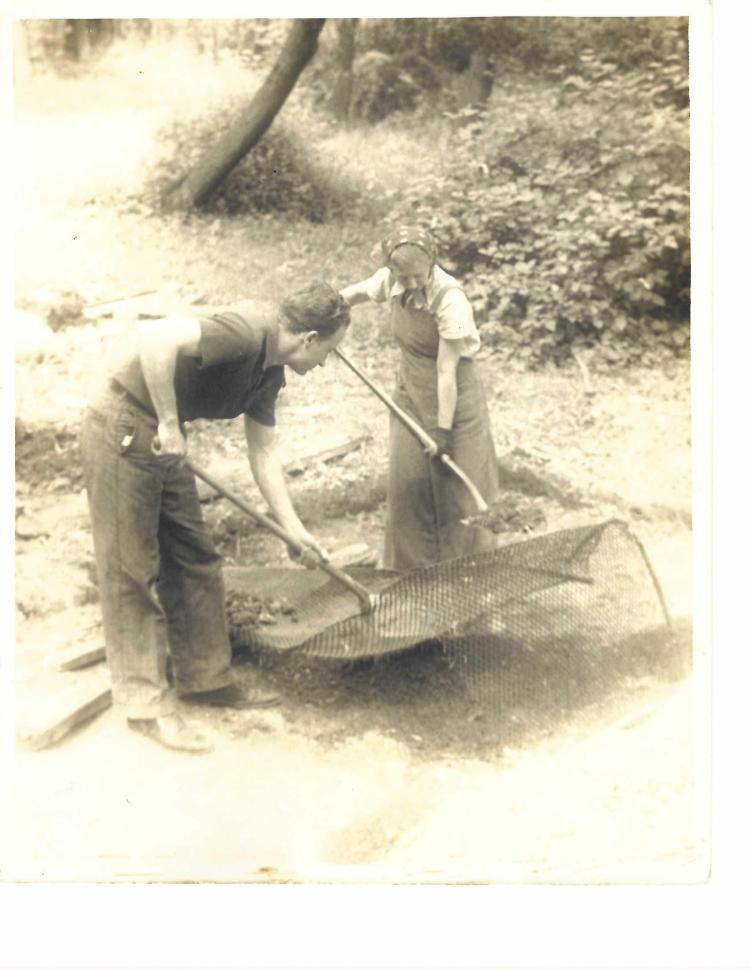
The picture shows the author’s parents, Robert Schnepfe Shaull and Clara Jane Shaull, apparently screening rocks from dirt, about 1940, certainly before the Great War.
Hello. Welcome to Tracks, a small collection of personal anecdotes intended to illustrate how come the author felt compelled to write about Demons, and also illuminate the nature of Demons, as they are referred to in this work. These anecdotes are provided for your free use if you would like to copy them, under a Creative Commons license CC BY 4.0. This license allows you to use a copy as you wish, so long as you say where you got it. The complete license may be viewed at CreativeCommons.org. I intend to present the anecdotes as if they were chapters in a very small book, in chronological order. Enjoy! No, wait, perhaps that’s not the word to use here…
Contents
My mother went crazy when I was about age six. Before then, she and my father were friends and lovers. They dreamed of buying a farm in the country…they were city folks originally. The farm dream came true after my father came home from World War II, even though the dream was tarnished by the nightmare house that sat on their dream farm. Our house was ancient, uninsulated, cold as ice in winter, hot as blazes in summer, lacking running water…water was pumped by hand from a well outside…lacking a bathroom…we went in an outhouse…the main house was filled with mice and the occasional black snake, even lacking enough bedrooms…only two, so that my parents slept in separate beds in the upstairs hall, thus yielding one bedroom for boy children, the other bedroom for girl children, and no room at all for hanky-pank in the night, a lack which only became clear to me many years later. I often wondered if it was our living situation that drove my mother over the brink.
As a child, I loved our farm. I loved the hills, the fragrant pine woods and the blowing grasses out in the fallow fields where wild strawberries grew. I loved the wild animals, deer, coons, foxes, rabbits, snakes and a multitude of birds, who never protested at our invasion of their territory. Sometimes at night, a bobcat would scream outside like a woman being tortured, and my blood would run cold. If I opened the door and looked out, it was seldom dark outside. Back then the night Sky was on fire with stars, and one night, my father saw Northern Lights flickering.
I mention my love of our Farm to indicate that perhaps my family members felt the same, and perhaps this explains why my parents did not break up, when they began fighting. They could have shared child custody, but they could not have shared the entire farm. It would have been parceled up in a divorce, and it might have been fear of this loss that kept my parents together until they died.
My father got a job in Baltimore City as inspector and chemist for the State Health Department. He commuted in every day from our farm about thirty miles north of Baltimore, so he would get home late and tired. My mother didn’t have a pay job, she ran the household and took care of my two siblings and me. Often in the years before she went crazy, my mother would put on a clean dress and lipstick when it was time for my father to come home. When he arrived, they would kiss. I assumed this was normal and the way things should be, and that someday I would copy my father and find a nice woman to share a family in my own home. After my mother went crazy, I dropped this notion for some years.
When my mother went berserk, the good times ended. She stopped preening for my father, and instead yelled at him for the most absurd reasons. Did this happen overnight, or was it gradual? I cannot recall, but at first it all revolved around powdered milk. My father wanted us to dilute our regular milk with a percentage of milk made from powder, which saved a few pennies. We all tried it, because he was our father. There were comments like Yeecchh! and It’s got lumps! and Can I have dessert now?
This went on some time, then suddenly one night, at dinner, as we argued over milk, my mother exploded with rage, at my father. My mother’s rages were a phenomenon. She would get red, her eyes would bulge, her head jut forward, her fists tremble for somebody’s neck as she stood leaning over the table confronting my father about his milk request. But by far the worse was my mother’s voice. Her voice was a psychological weapon akin to brainwashing or a mental firehose. The volume of her voice had to be experienced to be believed, and it came at your mind like a physical assault, robbing you of the ability to think or defend yourself or even flee, like a terrified possum caught in the headlights.
My father did not respond in kind to my mother’s rage, I don’t recall him saying anything, but he never gave up on the powdered milk question. My father would acquiesce to my mother’s rage, and drop the subject for two or three nights, but then I suppose our prodigal ways so disturbed him, that he could not help but repeat his quiet request that everyone drink a powdered milk blend he had mixed up…and my mother would explode all over again. See, attrition was my father’s mode of attack. After all, he was a pacifist in the War.
I also have a hunch that part of my mother’s fury was caused by my father’s persistence with the powdered milk issue. Then I have a hunch that my father expressed his own growing anger at her, by his dogged insistence on that same powdered milk. Neither of ‘em was gonna give a blamed inch, as they say. Of course, this had to be only the tip of some iceberg, to which I was not privy…yet…but gradually, I searched for clues.
You might wonder if my father had committed some terrible crime that my mother had discovered. Perhaps he was running slaves or whisky or a prostitution ring, instead of working for the State Health Department like he claimed. But on occasion in Summer, when school was out, he would take me with him to Baltimore and give me a tour of the lab where he worked. There his cohorts would gush over me, provide me with a white apron and safety goggles, say I looked like a future chemist, ask me what college I favored. My father would proudly show me around, demonstrating the microscopes, the centrifuges, the Bunsen burners, the beautiful old-fashion analytical balance in its glass case. He knew exactly which drawers to open for litmus paper or filter discs. That’s hard to fake, fellow workers, a whole lab. Of course, perhaps he was cooking street drugs in this lab, and only looked for rat hairs in bakery products as a cover! But no, it was too far-fetched, even I could see that.
At home, my father seemed like a decent sort, dull but good at putting food on the table. His main fault was that he worked too hard. Every Summer, in addition to his full-time pay job, he put in a vegetable garden that now fills my heart with envy to recall. It must have been a full acre he planted, all kept weedless. He grew everything, even watermelons and cantaloupe. His garden was so large that a farmer came and plowed it with a big agricultural tractor every Spring. As soon as he got home from his eight-hour job in Baltimore and the hour-long commute, my father would change and dash out to his garden, where he worked until it got too dark to see, only stopping to be screamed at by my mother over dinner. In the evenings, he would be so exhausted from working that if he tried to read to us children, he fell asleep on the sofa.
Did my father have a mistress that infuriated my mother? He was handsome, unlike my homely mother. My father was so handsome in his gardening outfit that both a photographer relative and a local painter asked to do his portrait, out in his garden, contemplating squash. There were times that he did come home late by an hour or so, but he always claimed a library visit, and he had the proof…a bag full of books for us to read.
My father did have a fault. I have no recollection of ever having an honest talk with him. I have no recollection of ever doing anything fun with him during my childhood, except that he let us children ride on his back, when we were very young, and later for a few years he read to us at night before bed, until he fell asleep. After that, nothing. And I can say this now that they are dead. One night I woke up when my parents were having sex, and I listened to them, out in the hall where they slept. Afterwards, my mother whispered little things, my father’s name, meaningless things, over and over. Love talk. What did I hear from my father? He chuckled.
There’s a good chance that my father was stuggling to keep from falling asleep…and that my mother was not satisfied emotionally. Of course, that’s conjecture.
When my mother flew into rages, my father never responded. Later when I openly taunted him, my father never punished me. My father was elsewhere. He was very good at putting food on our table year after year, but women need more than food. Perhaps my mother was starving for affection, and it drove her mad.
In the Great War, my father refused to pick up a weapon, and not out of cowardice, because he asked to be a medic and parachute from an airplane along with the troops into enemy territory, and his decision was noble, and perhaps shaped him for life into a pacifist who was respected for getting a difficult job done, not for fighting. I believe that this experience etched deeply into his mind and heart, so that later when the farm bills came in, the house was falling apart around him and the car was often broken down so he had to hitch-hike to work, my father must have wondered if the War had become some sort of guerilla campaign.
What did my mother want from life? I had these clues. She joined a local prayer group which she attended fanatically, and perhaps she fell in love with the handsome and devout minister who ran this group. I met this man several times, he married me to my first wife, he was very impressive. In his presence, I reconsidered atheism, not on theological grounds, but because I perceived that righteousness could be sexy. I can easily imagine my mother comparing my father to this divine hunk and coming up short. I had first-hand evidence that my mother craved long, intimate discussions about spiritual love and the like, a craving she may have satisfied with the minister, but would have put my father to sleep even faster than reading to us at night.
During one of my mother’s rages outside in my father’s garden one summer day, precipitated by my father asking us children to help him weed, my mother bellowed out at all of us, at the top of her operatic voice…“NONE OF YOU LOVE ME THE WAY THAT I LOVE YOU!!!” This declaration was so spontaneously honest, so appalling, so revealing, so fraught with contradiction, that it put an end to her outburst…that day.
Down through the years, my relatives and I have come up with various other explanations for what went down in that old house. Here’s a list of the various theories as to my mother’s malady: poisoning from lead paint, spoiled preserves, or DDT; a dietary mineral deficiency (not enough dairy products); heredity (my maternal grandfather was weird); terrible living conditions; social isolation; emotional incompatibility; poverty; post-partum depression (after my brother’s birth); premature change of life; tick-borne disease; inhaling mold spores and seasonal affective disorder (inadequate lighting).
At first my mother only yelled at my father at dinner and if he dared ask one of us to give him a hand in his garden or if she disapproved of his driving or if he expressed an opinion on anything, but soon, she escalated. After she put us to bed, she began lighting into my father, who must have been dead on his feet by then. My room was right above the kitchen where she always cornered him, and I could hear every one of her screamed words. She claimed that my father began to curse her in retaliation, but I never heard him do so.
What I soon did hear during those fights, was the unmistakable sound of a fist striking flesh. Along with my mother’s screams and sobs, and sometimes, the hurled plates or something that shattered. To this day, I do not know which of them was hitting the other, or if they both were. But I am certain of what I did hear. Some things do not fade.
I lay above them in my bed, my pajamas and often my sheets wet with the sweat of my terror. I became convinced that one of my parents would soon kill the other, then kill us children…and finally, themselves.
Where did I get this idea? The truth is lost, but here’s my theories: personal abuse by neighborhood bullies; media representations of typical human behavior; architypes of the unconscious (C. J. Jung); a dream; my fevered imagination. Whatever the source, once the suggestion took root in my mind, it seemed inevitable. I resolved to find a way to protect not only myself, but my younger siblings, from our parents who had become Demons. I whittled a club but realized this was futile, for two reasons. Firstly, I was too weak and too small to bash anybody. Secondly, I did not believe that it would work. If it was my father who came up the stairs, chaos bound, he would simply take a club away from me. If it was my mother, she would bellow and I would become paralyzed. And then…well.
My luck turned when our family visited an aunt and uncle in Baltimore. I was fond of this uncle. He had a studio in his attic where he earned a living as a commercial artist his entire professional life, raising two children on his earnings.
Poking about where I had no right to be, I found an ancient shotgun in my uncle’s closet, and perceived immediately that it was the answer to my problem. I cajoled my uncle into giving the gun to me, since it was too rusted to work anyway. This gun was in bad shape. The barrel was slightly bent, as if used to whack somebody over the head, and split for about two inches at the end. It was so rusty inside that it took me awhile with steel wool, screwdrivers and oil to get it to open at the breech, and the trigger and firing pin to work. I asked my father to buy me a box of shells, 12-gauge buckshot, claiming that I was going to shoot the groundhogs in our fields. He bought me the ammo, never suspecting my true intent.
I put one shell in the gun and fired it from a distance by pulling the trigger with a string, to see if it exploded. It did not. The chamber was so pitted from corrosion that I had to pry the spent cartridge out with a screwdriver.
Then I tried shooting the gun in the standard way, against my shoulder. The damn thing kicked me so hard I saw lights flash, and not from any muzzle blast. I never could shoot that gun more than once at a time, then wait for a few days for the bruises to stop hurting. Sometimes the recoil would make my nose bleed. It was a bitch, that gun, but it would throw an ounce of lead, no question of that. An ounce and an eighth, if I bought the magnum load. I cherished that gun. I kept it by my bed every night, with shells close by, and I made sure that my quarreling parents understood that I was armed, and not to be messed with.
After a year or so, my parents stopped the fights at night, but not from any reconciliation. Their love appeared dead to me. From that time on, their interactions were only hostile, or at best, a weariness. My mother only spoke to my father to criticize him. My father might mutter vague objections, but mostly, he ignored her. They continued to tolerate each other’s presence and the formalities of marriage until their physical deaths decades later.
I have to admit that I also began to criticize my father, surely in imitation of my mother. My behavior towards him was blatantly disrespectful. Yet he never punished me for it.
Only once did I ever see my father express his feelings about the abuse and disrespect he got from my mother and me. Our family went to a Fourth of July fireworks in a neighboring town. I drove, so I must have been a teenager and my parents must have been out of love for at least a decade by then. On the way to the fireworks, as usual my mother criticized my father, who said nothing as usual. When I parked the car, we all got out. There was a crowd all around for the fireworks display. We all got the stuff we needed out of the car. I locked the car doors.
Usually if our family went out on the town, we children walked ahead as fast as we could, to appear unassociated with our parents trailing behind. But this time, before we even got a chance to walk off, a problem loomed. My father had vanished. Gone. We all halted, purpose derailed, bewilderment blooming. Somebody murmured that perhaps he had to pee and ran for a bathroom, so we huddled and waited. People walked around us, time passed. My father did not appear. Slowly, gradually…I realized that he was not coming back. I was stunned.
To me, there was not the slightest doubt as to why my father disappeared. He was sick and tired of us. Not just of my mother…of me also, because I had become her accomplice in his torment. In that moment, my cruelty was revealed to me like a landscape seen by lightening flash. The shotgun, the taunting…I was not worthy to be anybody’s son.
Finally in a trance, we all walked to the fireworks, letting the crowd take us along. The whole time I was thinking, I should not be following my mother, who drove my father away. I should walk away from her right now, and go find my father, and not say a word to him, just nod, just be with him and watch fireworks, then go home.
But I did nothing. I, wild west shotgun man, could not even walk away from a bossy, rude woman, let alone stand up for a wronged man, when a showdown came. I followed my mother like the zombie I had become. Had I walked from her that day, had I found my father, I would be different now. But I am the same.
Sure it’s true, that I did try to break free. I got a shotgun and made ready to kill my parents. That was my sole gesture of protest, betrayed by its absurd excess, for the weakness it was.
When we returned to the car after the fireworks, my father appeared. Not a word was spoken by anybody. We all got in the car and went back in silence to the structure we called home.
I believe that my parents did not realize the importance of rituals of intimacy. My mother felt that the rituals of religion and spirituality were more important. My father felt that the rituals of prosperity were more important. Intimacy died like a plant without sunlight, and with intimacy died compassion, and then we became a ship of strangers, with fists hitting flesh in the night, and a son with a shotgun ready by his bed. The echoes of this failure resonate yet.
Why a ritual? Because when people have to work very hard, as my parents did, it’s tempting to postpone intimacy unless it is a sacred habit. What kind of rituals? We might have taken every Sunday afternoon, just to mess around, as a family. Play games. Sit and talk. Go for a drive. Have a cookout. Play music. These games seem unimportant, easy to overlook. Like air.
WhippoorwillO is the story of how Black slaves in colonial America search for their rituals of intimacy on the very threshold of Hell, and what they come up with.
 WhippoorwillO